Thursday, September 24, 2015

Genius Hour - Take 4


This week, we kicked off Genius Hour by reading But I Read It on the Internet by Toni Buzzeo and Reach for the Stars and Other Advice for Life's Journey by Serge Bloch. Both great books and highly recommended! Buzzeo's book laid the ground work for great discussion about researching on the internet. Very appropriate for 3rd grade and they were all very engaged! In the book, the awesome librarian shares a "Gizmo" with students - a website evaluation tool. This is something I want to create for Genius Hour research for my kids. Need to think about it and how I want it to look... Perhaps even a half sheet of laminated paper with a checklist to refer to?

After our inspirational reads, we moved on to internet searches. We practiced searching for a topic and citing our source. In Buzzeo's book, the librarian teaches kids to check out the "URL". Today's GH goal: find one fact on and write it on a piece of loose leaf paper. Underneath your fact, write the URL. We practiced shortening it up a bit and only writing until the first slash. This seemed to work well with the kids.

After we searched on our Chromebooks for a bit, we took a shot at our new reflection page. Two simple questions:
1. What is one thing that went GREAT today?
2. What is one thing that was challenging today?

Heartbreak of the day, right here folks...


We then excitedly got our new folders. I gave each student a plastic, 3 pronged folder to keep their GH work in each week. Passing out folders and practicing putting our papers in was pretty exciting stuff! I really liked the folders and I think they will definitely help keep these third graders much better organized.

Overall, today's Genius Hour session went much smoother. Every single child was engaged and excited. I feel like that makes it a success in and of itself.

I have recruited my dear friend and Library Media Specialists for next week's Genius Hour....(insert music and dun, dun, dun sound). We are going to collaborate this week and decide - explore databases? Practice internet research? Practice book research?


Sunday, September 20, 2015

Genius Hour 3

This week's Genius Hour Plan: Complete a Project Proposal. We first read two great books: The OK Book by Amy Krouse Rosenthal and 11 Experiments that Failed by Jenny Offill. The kids enjoyed them both. They especially loved 11 Experiments that Failed, as we have been conducting experiments about the states of matter.


Students were asked to complete the following questions:

  • Name
  • Date
  • Topic
  • My INQUIRY question will be (What are you wondering about?):
  • Materials I need for my research (How do you plan to find the answer to your question?):
  • How do you plan to show/share/present your research findings?
  • Teacher Approval

By the end of last week, I had conferenced with each student and worked with them to create an inquiry question. This week, two students had completely forgotten their topics! Most of them did however, remember their exact question. Overall, students had difficulty answering these questions - even with modeling and assistance. Many students were demonstrating the exact reason that I wanted to implement Genius Hour - they were scared to take a risk. This task wasn't a workbook page or a defined set of problems, this was open ended and much more difficult for them. 

We worked on these proposals for most of the period. With about 15 minutes left, I asked students to complete the daily log reflection (posted last week). This was a complete flop. I am going to take off the "Notes" and "Resources" boxes and simply create a new form that focusing on reflection. The theme of Genius Hour Week 3 was - HOT MESS. I felt a little discouraged, but then remembered our classroom's precept of the month...


Friday, September 11, 2015

Genius Hour 2

Today we had our 2nd Genius Hour. We read The Magnificent Thing by Ashley Spires and Olivia's Birds: Saving the Gulf by Olivia Bouler. Many of the kids had read The Magnificent Thing, which surprised me because I had not heard of it before exploring Genius Hour this summer.The kids LOVED both books. They were very engaged and amazed that an eleven-year-old girl wrote a book! Some got a twinkle in their eyes.... You could see them thinking, "Hey, I could do that!"

I then told the kids that we were going to continue brainstorming using our electronic "Wonder Wall" - a shared Google Doc. The kids were immediately excited - time to use their Chromebooks! They weren't quite excited about what we were actually doing yet. This was a great idea. Or, so I thought... The kids were not focused on brainstorming, they were very concerned about what other kids were doing and who was writing in their "box" (I created a table and each student was designated a box to brainstorm in). The shared Doc was also updating a little slowly and lagging in updating, which is completely understandable as there were 20 people using it at the same time! I decided to pull the plug about half way through and have the kids create their own Google Doc and share it with me. I told them to type in "Sarah Simac". They were amazed that I had a first name! The stress level in the room instantly decreased.

I want to note that before we began brainstorming, I told the kids that we would decide at the end of the period if we were going to do one group project or individual projects.

As our Genius Hour went on, the kids became more and more interested in their own ideas. I then began conferencing with each student. There were some kids that definitely needed more modeling and prompting through the brainstorming process. There were also some kids that completely blew me away. My favorite was a little girl who recently donated her hair to an organization that makes wigs for children with Cancer and other diseases. She wanted to learn, "How can I get other kids to cut their hair?" She will be making a PSA that we are going to share with the school and world on Youtube! I just finished individually emailing parents about their child's choice of topic for Genius Hour. The goal for next week: tweak our big QUESTION and work on a Project Plan. I also want students to reflect and complete our Genius Hour Project Log.


Friday, September 4, 2015

Genius Hour 1

Today marks the end of our first week of school, and what an amazing week it was! The students were eager to learn and ready to go! I have to note that this year, I believe the beginning of the week went exceptionally well. I am so lucky that I have taught this group in kindergarten, 2nd grade, and now 3rd grade! I have had over half of the students in class before. I have been fortunate enough to work with the rest of the students in other grade level activities. Needless to say, I not only know all of my students - I have relationships with them. I was not going to start Genius Hour this early in the year, but decided to jump right in!

On the 2nd day of school, the students carried their "Chrome Eggs" around. These were hardboiled eggs that we pretended were our Chromebooks. There were a lot of cracked "Chromebooks"; however, I believe the activity was extremely successful. We reflected as a class and came up with great lists of how to handle our Chromebooks appropriately and what not to do. The next day, students were given their Chromebooks and taught the basics. Today, they learned how to access Drive, how to create a Google Doc, and how to share a Doc with others. During this lesson a light bulb went off in my head... we would brainstorm on a shared Google Doc!

This afternoon, we started our FIRST Genius Hour! We began by watching and discussing a Prezi that I made - click HERE to view. We then looked up the word Genius and found the following definition:
: a very smart or talented person : a person who has a level of talent or intelligence that is very rare or remarkable
: a person who is very good at doing something
: great natural ability : remarkable talent or intelligence
We had a great discussion about what genius was, that led naturally into an in depth about passion and things that got us excited!
I had students fill out an interest survey:

Name: _______________________Date: ________________
Think FAST! What are 3 things you wonder about?
1._______________________________________________

2. .______________________________________________

3. _______________________________________________
What do you like to do most at home?
________________________________________________
What are your favorite hobbies?
________________________________________________
What are your favorite books or magazines?
________________________________________________
My Favorite:
Team: ______________________________________________
Game:  _____________________________________________
Animal:  ____________________________________________
Musical Group:  ______________________________________
Sport:  _____________________________________________
Subject in School:  ____________________________________


This was a great idea; however, it was overwhelming for some of my students who have difficulty reading and writing. I did write for some students, but decided to scrap it about half way through. I then opened up a Google Doc that I named "Genius Hour - Wonder Wall" and shared with students. Click HERE to view our shared Doc. Unfortunately, we only had about 10 minutes to work on the shared Doc and we had to go to P.E., Power Hour, then HOME! I did share the Doc with parents and invited them to check their child's progress and add ideas with their child whenever they'd like.

Excited for next week!

Friday, August 21, 2015

Student Reflection

Our elementary school currently uses a daily planner in grades 3-5 to record activities and assignments. True to the title of my blog, I have moved on up again. This year, I will begin my first 3rd/4th grade loop. I am very excited and could go on forever about that excitement, but back to reflection!

Our principal has already ordered us planners. Our PBIS committee has been brainstorming ways to incorporate a spot for our students to reflect on our expected behaviors: be safe, be responsible, and be respectful. Last year, one of our amazing teachers created and combined a planner and behavior reflection piece all into one. Using her planner would entail weekly copying for each student.

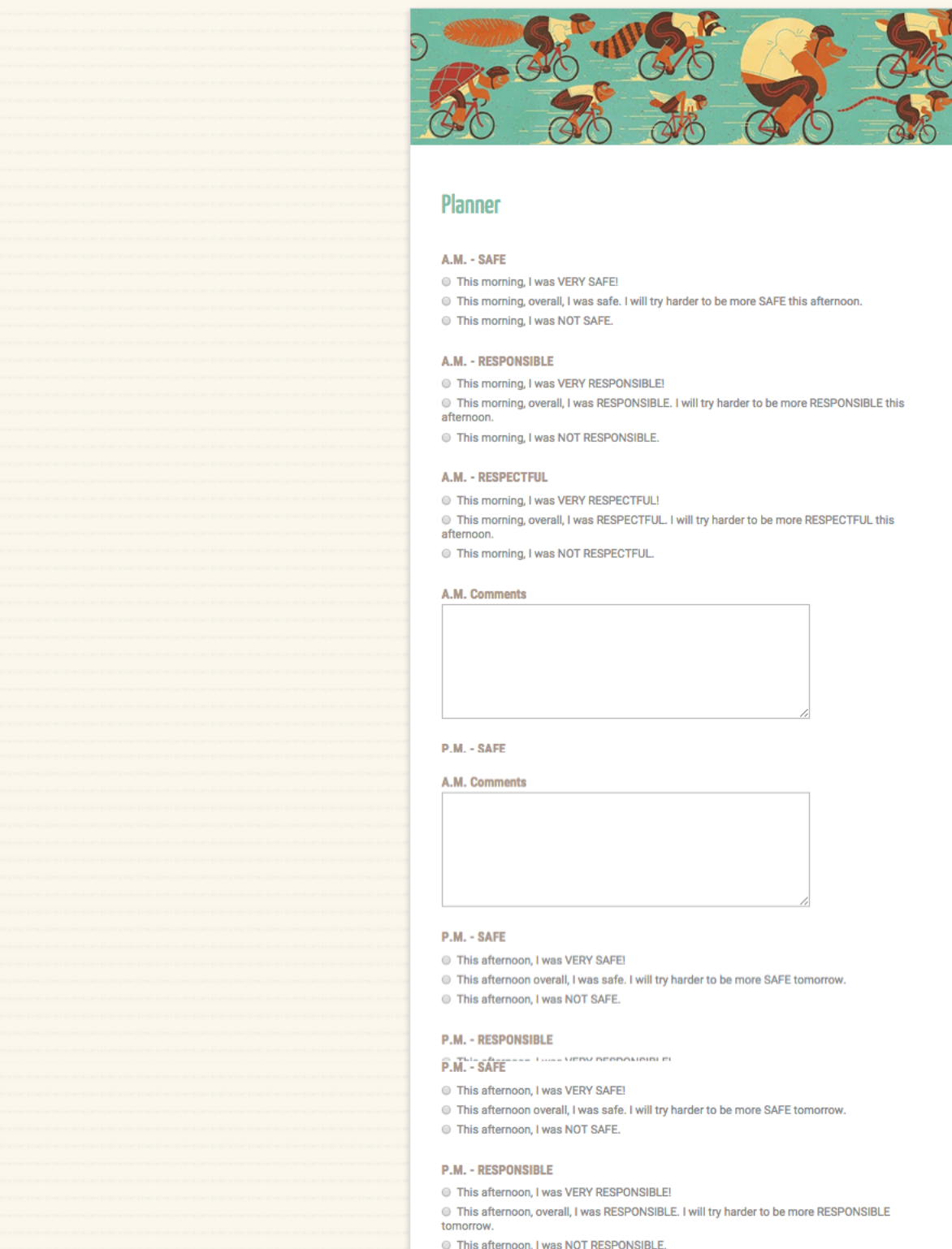
In an attempt to save resources and utilize our chromebooks (newly 1:1 in grades 3-5), I have created a google form. My thought is to make a copy of the form for each student, and share it with them and their families. This is a snapshot of the form, but not the entire thing. It also got distorted when taking the screenshot. There is an additional text response box for students to tell something they learned or something exciting from the day. I love this piece and am excited to use it as an exit ticket for students. We are meeting as a grade level next week, and I am excited to share this with my co-workers! Please feel free to offer any feedback or suggestions, thanks!


Tuesday, August 4, 2015

Pure Genius

I am currently reading Pure Genius: Building a Culture of Innovation and Taking 20% to the Next Level by Don Wettrick. I decided to write this reflection a little differently than other book reflections I have written in the past. Instead of taking notes, reviewing my notes, and reflecting; I am going to stop intermittently in the book and jot down some ideas as they strike me! This blog will basically be my notes to reflect upon.

LOVED Wettrick’s discussion about Dave Grohl (drummer for Nirvana and front man of Foo Fighters). Grohl basically says that now people are making music on computers, altering sounds using software. People are winning contests on reality shows that they are just singing someone else’s song on. Musicians need to fail. They need to record, rerecord, play cheap shows with poor equipment. Then, when they do make it – their music is organic and filled with passion, because they have poured their hearts into it. This is not only a great analogy for education, but for many things in life!

I also thought Wettrick’s comparison of education and gaming was brilliant. We often hear that kids and adults alike, love games. I love candy crush!  However, think about our classrooms. If I told all students they had to start at level one. No matter what, even if they had already completed level 22; everyone was starting at one. That’s not how we should be teaching, leading or guiding our students.


Key points from chapter one:
  • Innovation Class is one in which students can have time and space to create their own learning experiences and collaborate with experts from around the world. It is also a place where students learn by doing and creating, rather than passively listening to a set of directions and pre-determined outcomes. And although we make sure to meet our standards, the focus is less on compliance and more on self-discovery and the pursuit of curiosity and knowledge building. YES! I love Wettrick's explanation of Innovation Class. This will be very helpful when explaining Genius Hour to parents this fall. 
  • Innovation is always a work in progress, always evolving.
  • One of the most important steps when problem solving is to ask the right questions. This reminds me of what Dave Burgess said in his book, Teach Like A Pirate: framing everything with the right questions is extremely important. It changes the way your brain thinks about things! Creative questioning helps us change our thinking and frame things as possible instead of just assuming we can't do it.
  • Innovation uses a fresh approach to solving real problems with the resources you have and finding clever ways around the resources you don't have...Innovation brings new solutions to problems that arise in a changing environment. This is completely in line with what I tell my students - be solution people, not problem people! Innovative people are solution people by definition. I will definitely share this with the kids and make the connections to solving problems instead of stating them.
  • I just finished up Learn Like a Pirate by Paul Solarz. One of my goals for the upcoming school year is to create and foster a student-led classroom. I want students to take ownership and responsibility in our classroom. Wettrick ties this in seamlessly, Students are asked to take ownership of their education. Instead of teachers putting a standard on the board and telling them how to meet it, students are given the challenge to prove they have mastered the required standards. They are also given the freedom to choose the method for completing the projects they choose. My 2nd goal for the upcoming school year - implement Genius Hour! Students will be working towards standards; however, instead of me speaking to them directly and then assessing them on what they heard/learned, the students will be choosing how they are going to demonstrate their knowledge of the standards and content to me.
  • Working towards anything important to you means that you have to be willing to fail!
The Puzzle of Motivation by Dan Pink - click HERE! Wettrick suggests this TED video on motivation. Very interesting! Pink talks about the 3 things needed to motivate people: 
  1. autonomy - independence!
  2. mastery - need and desire to learn more!
  3. purpose - doing this for a bigger reason!
This TED video and the research provided in it, support Genius Hour/20 Time tremendously!

Wettrick discusses creating a "Culture of Freedom from Day One". This had a big impact on me. He points out that students are excited the first day of school - they are excited to see their friends, bring in their new school supplies, etc. While building a collaborative classroom community, it is important not to squash that enthusiasm by telling them everything they canNOT do. Spend the first days telling them all of the exciting things that we will be doing in class.

According to Wettrick, there IS NO PLAN! However, there are guidelines:
  • Project Based Learning; however, the teacher is not choosing the topic which typically happens in a project based learning environment.
  • Students research topic of their choice, personal interest - this is hard for students! Many have not had this type of freedom before. Hold a classroom brainstorming session. Research how to EFFECTIVELY brainstorm. Also, create surveys for the kids to help get them thinking about their passions. Thought - have them research solutions to a local problem or a problem that they can make better. Something to do for our first whole group Genius Hour project. Do one together to model the process?
  • Students can work individually or in groups (should be nor more than 3). If students do choose to work in groups, come up with possible "roles" to keep all on tasks. 
  • Students must collaborate with outside expert (person from the community, Facebook contact, Twitter, Skype, etc.)
  • Project plan? Hmmmm.... Wettrick suggests a project plan for high school Innovation course. Is this necessary in 3rd grade? I am thinking just an end product in mind. Will create some type of graphic organizer for 3rd graders.
  • Reflection after each work period, what did they do? What did they learn? What did they find? Blog or VLOG - video blog??
  • Presentations (will hold family night at the end of the year).
6 Building Blocks of Innovative Learning:
  1. Collaboration: Students need to collaborate with each other and they also need to collaborate with experts outside of the classroom. The real world interactions are authentic and will provide them with real world experiences.
  2. Task- Oriented: Often students are extremely excited about the big ideas; however, they then don't know how to go from idea to project. Help them create a list of tasks, goals, and a timeline for completion. Make sure to not only set a final timeline, but a timeline along the way for each task.
  3. Daring: Students need to be fearless and be risk-takers! Create a classroom with the freedom to fail!
  4. Relevant: In this scenario, relevant means to have students solve real world problems that they can see the benefits of their solutions. Challenge students to create a meaningful project.
  5. Reflective: Constantly reflect - students and teacher!!! Reflection helps us to see how to improve and to also correct any misconceptions or mistakes.
  6. Ongoing: Some projects have long lasting impacts that go beyond the school year. Some projects just simply can't be finished by the end of the school year. Older students can absolutely follow through on their own, and they should as it is a PASSION project. However, not sure how realistic this is for 3rd grade. Will play this by ear...
Wettrick also discusses social media for both teachers and students. I have decided to again have a daily student "Tweeter". The daily student Tweeter will send out a daily tweet sharing something from their day - a project, something they learned, a picture, something fun or silly, etc. Our class will also use Twitter to connect and collaborate with other classes (Mystery Skype) and experts (as mentors for Genius Hour projects). Our class will also have a Facebook page; however, I will be in control of it for the time being. It is new and I want to do a trial as a class, just as I had with Twitter in the past. Our school board recently approved a new social media policy, so we are still navigating these unchartered waters... I will be sharing a letter with families at open house about our Facebook page (see below). I started to write the pros of social media; however, decided to keep it short and sweet. I would rather discuss it with the parents in person at our Open House. This will give them the opportunity to ask questions and me the opportunity to address them directly.

Click HERE to read my letter to parents about Facebook.

Sunday, August 2, 2015

Learn Like A Pirate

I just finished Learn Like A Pirate by Paul Solarz and my mind is spinning. It was full of such GREAT information. I bought and read Learn Like A Pirate with my end goal in mind - a Student Led classroom. I want students to be independent thinkers and learners. I want students to be solution people, not problem people. This came to be from the learned helplessness that was abundant in my classroom last year (see Freedom to Fail blog post).

This upcoming school year, and for all the school years after, I will focus on improvement and welcome failure. I believe that I did this before; however, my biggest mistake was not conveying this message to students and teaching them to believe it and live it.

I have used and abused my trusty highlighter when reading this book. I also went through a pile of post-its and a notebook full of scribbles about all of the key points. This blog is my reflection on what will I change in my classroom for the upcoming school year.

1. Give Me Five - I will empower all students to be equal parts in our classroom by allowing them to signal (raising their hand) and get the attention of their classmates by saying, "Give me five," when they want the attention of the entire class. I will teach students that this is a privilege. We must respect when other students are talking (silence our mouths, freeze our bodies). This is not to be used in specials (art, music, PE, etc.) or with substitute teachers. I will express great appreciation to students who use it correctly. When students interrupt at inopportune times, I will use it as a teachable moment.

2. Daily Goal - At the end of each day, students will write in their daily planners and reflect on their own behaviors - were they safe, respectful, and responsible? We will also set a goal for the next day. What can we do better as a class?

3. Strategies for Dealing with Conflict - Last year, it seemed that there were always students running up to me. I consistently asked students if they were "tattling" or "reporting". We went over the differences between the two in depth, multiple times throughout the school year.  Solarz gives three strategies to teach students to resolve conflict on their own:

  • Rock-Paper-Scissors: When someone HAS to win or be right, break it down to a good old fashioned game of rock-paper-scissors.
  • Compromise: Take ideas from each person and figure out a solution using both. For example, two students are working together, Sophia and Natalie. Sophia wants to search for information on a website and Natalie wants to search for information in the library. They are instructed to work together. Compromise - do both! One will have to be done first, but figure it out! It is a win-win situation for all involved.
  • Be Kind: Truly think about what the other person wants to do. If it is a good idea, do it!
4. Silent Day - Tell the kids that they are working towards a goal: Silent Day. For Silent Day, I will be quiet the entire day. I will not say a word. I will not bless someone when they sneeze, I will not say thank you - nothing! In order to do this, they will need to practice throughout the school year and show me that they can make decisions and handle things as responsibly and independently as possible.

Solarz also gave plenty of other great instructional strategies to implement. I am excited and focused on beginning the school year teaching the kids what a student-led classroom is and how we will become one!